


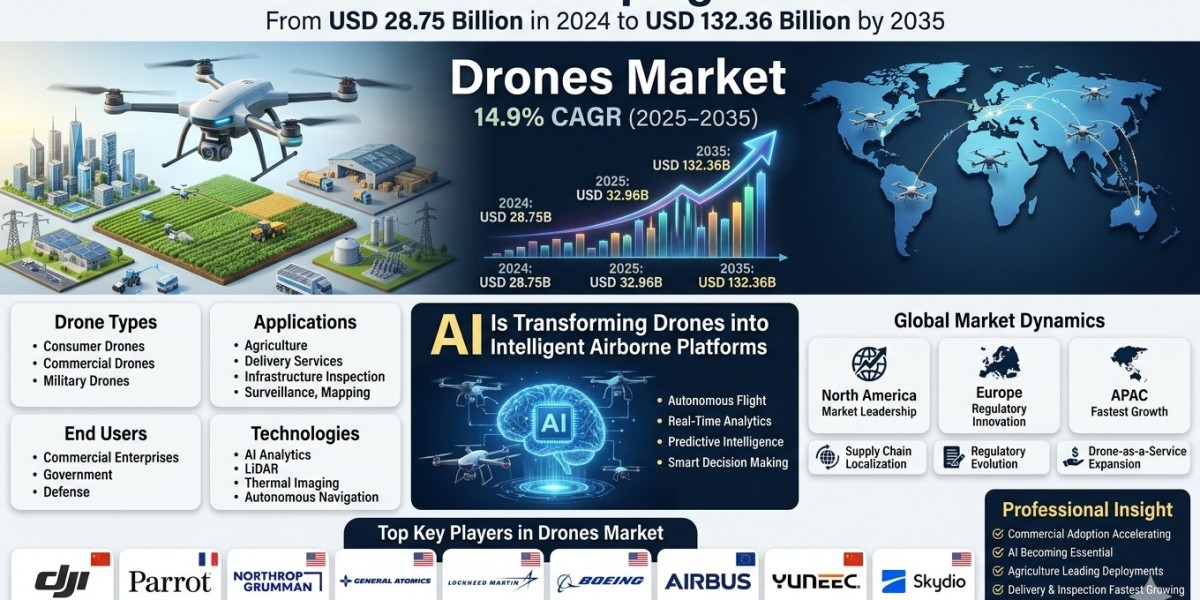
The Drones Market is becoming increasingly diverse as unmanned aerial platforms find applications across commercial, civil, industrial, and consumer environments. The technology provides organizations with an aerial method for collecting information, observing assets, supporting field activities, and reaching locations that can be difficult to access through conventional methods. As drone capabilities continue to develop, their role is gradually expanding from individual flights toward structured operational programs.
The expansion of drone-based aerial solutions reflects this shift toward broader professional use. These solutions can combine aircraft platforms with sensors, software, communication systems, data processing tools, and specialized payloads. Instead of viewing a drone simply as a flying machine, organizations can use the complete system to collect and process information for specific operational requirements.
Public safety is one area where drones can provide useful capabilities. Emergency teams may use aerial platforms to observe large areas, assess conditions following incidents, locate people, or support situational awareness. From an elevated position, a drone can provide information that may be difficult to obtain quickly from the ground. This can be particularly relevant in environments affected by natural events, infrastructure failures, or other emergencies.
Environmental monitoring is another developing application. Drones can support observation of forests, coastlines, agricultural areas, water bodies, and other natural environments. Frequent aerial observations can create a record of changing conditions and help organizations understand physical developments over time. Specialized sensors can further expand the types of information that can be collected.
Mining and resource-related industries can also benefit from aerial mapping and surveying. Drone platforms can collect images and spatial information across large operational areas. Such information may support site planning, stockpile observation, terrain analysis, and general operational monitoring. The aerial perspective can complement traditional surveying approaches and provide additional visual context.
The entertainment and media sector represents a more familiar application. Drones have changed the way aerial imagery can be captured for films, events, advertising, sports coverage, and other visual productions. Compact aerial systems can provide dynamic perspectives that were previously more difficult or expensive to obtain. Advances in stabilization and camera technology have further improved the quality of aerial content.
Another important opportunity lies in data analytics. A drone flight generates information, but the long-term value often depends on how that information is processed. Image analysis, mapping, artificial intelligence, and automated reporting can help convert raw aerial data into useful operational insights. This creates opportunities for software providers and service companies alongside drone manufacturers.
The development of autonomous systems could further expand commercial applications. Automated flight planning, obstacle avoidance, navigation assistance, and coordinated operations may reduce the complexity associated with repeated missions. Organizations could eventually operate drone fleets according to predefined workflows, with human personnel focusing more on supervision and analysis.
At the same time, responsible deployment remains essential. Operators need to consider airspace rules, privacy, cybersecurity, weather, maintenance, data management, and workforce training. The technology itself is only one part of a successful drone program; operational procedures and compliance frameworks are equally important.
Overall, the Drones Market is developing through the convergence of aviation, robotics, software, sensors, artificial intelligence, and data analytics. Future opportunities are likely to emerge where these technologies solve specific operational problems. As businesses and public organizations gain greater familiarity with drone-based workflows, aerial platforms may become increasingly integrated into routine monitoring, inspection, mapping, and information-management activities.
FAQs
- Which industries can benefit from drone technology?
Agriculture, construction, energy, infrastructure, mining, logistics, public safety, environmental monitoring, media, entertainment, and surveying can all use drones for different operational purposes.
- What is the role of data analytics in drone applications?
Data analytics helps transform aerial imagery and sensor information into usable insights, supporting activities such as mapping, inspection, monitoring, classification, and operational decision-making.